|
1
|
|
|
2
|
- All observational astronomy is basically a matter of recording photons,
be they visible, infrared, gamma rays, or radio.
- It all reduces to one of two things:
- Seeing how the photons are distributed over a two-dimensional space
(taking an image), or...
- Measuring how many photons arrive per unit of time (taking photometry).
- It does not matter if your detector is your eye, a CCD, or a heterodyne
receiver; you still are counting photons.
|
|
3
|
- The concept of astronomical photometry
dates from Ptolemy in the 2nd Century A.D.
- Ptolemy divided the stars into 6 degrees of magnitude from the brightest
– magnitude 1 – to the faintest visible with the naked eye – magnitude 6.
- It is Ptolemy that we must thank/blame for introducing photometry and
the concept of photometric
calibration.
|
|
4
|
- All the systems of photometry that exist today are based on Ptolemy’s
original system.
- Remarkably, with just a few exceptions, Ptolemy’s magnitudes agree well
with modern photometry (although to low precision).
- We now define the magnitude scale mathematically such that a difference
of 5 magnitudes is a factor of 100 in brightness.
- Or, a difference of 1 magnitude is a factor of 100.4 in the
“irradiance of the detector”.
|
|
5
|
- 2000 years ago everything was far simpler.
- The only detector in use was the naked eye.
- The magnitude scale only had to deal with a range of less than three
orders of magnitude in brightness – the difference between Sirius and
the faintest star visible to the naked eye.
- Now the magnitude scale must cover »55 magnitudes (11 orders of magnitude in
brightness) from the Sun – magnitude –26.7 – to the faintest stars
detectable with the Hubble.
- And it has extended to other ranges than the visible.
|
|
6
|
- By the 1950s it had become obvious that it was necessary to have both a
list of stars apt for the calibration of photoelectric instruments and a
common photometric system for astronomers to use.
- A series of defined photometric bands.
- Stars with a known magnitude in each band.
|
|
7
|
- The basis of the modern “Johnson” system that is still the most common
today (Johnson & Morgan, 1951, Astrophysical Journal, 114, 522) is:
- A photometric criterion such that, measured OUTSIDE the atmosphere...
- For a normal A0V star: (B-V)=(U-B)=0.0
- For a giant K0 (K0III) star: (B-V)=(U-B)=+1.0
- The spectral types were defined in the revised Yerkes system (Morgan,
Keenan & Kellman, 1943, "An Atlas of Stellar Spectra with an
Outline of Spectral Classification", Astrophysics Monographs,
University of Chicago Press).
|
|
8
|
- Three standard photometric bands: U (ultraviolet), B (blue), & Y
(yellow-green, now “V”). These were the basis of modern broad-band UBV
filters.
- The UBV as defined above was refined by Johnson & Harris (1954,
Ap.J., 120, 196) and by Johnson (1955, Ann. Astrophysics, 18, 292),
becoming the standard system for all visible photoelectric photometry
and, by extension, all spectrophotometry.
|
|
9
|
- In parallel, other workers defined the red bands:
- First defined in 1951, principally due to the work of Kron.
- A new R filter was defined in 1951 by Lynn Smith (1951, PASP, 63, 91).
- Johnson attempted to define an alternative system in 1966, but it was
little accepted.
- The current system was defined by Cousins (1976, MNRAS, 81, 25). This
gave rise to the current Kron-Cousins system in RI.
- The system that all astronomers use, amateur, professional, visual, or
CCD is thus... “Johnson-Kron-Cousins”.
- This system was the result of more than 30 years of work.
|
|
10
|
- After 50 years, UBVRI is showing its age.
- It was designed for photoelectric photometers, which ceased to be used
some 20 years ago.
- U has fallen into disuse.
- I comes in almost as many varieties as ice cream.
- The UBVRI system was ideal for observing galaxies but, is far from
ideal for photometry of stars.
- The bands are too wide for separating the main spectral lines.
- Makes measuring the physical properties of stars extremely difficult.
- Many different alternative systems were thus defined (Strömgren,
narrow band, Gunn, etc). Very confusing. Difficult to compare data.
- And…
|
|
11
|
- There is a calibration crisis.
- There are few well-calibrated stars, mainly around the equator.
- The faintest well-calibrated stars in UBVRI are around magnitude 15,
but astronomers are regularly observing objects that are magnitude 25
and fainter.
- A 10-m telescope will saturate in 1s at magnitude 19!!!
- Even the “ultimate” photometric catalogue – Tycho – has major problems
- Like Claudia Schiffer, it looks good on the outside.
- But, the discerning astronomer really needs something that goes a lot
deeper.
- It comes with a lot of baggage and style issues. What looks good, may
not be apt for normal, daily use.
|
|
12
|
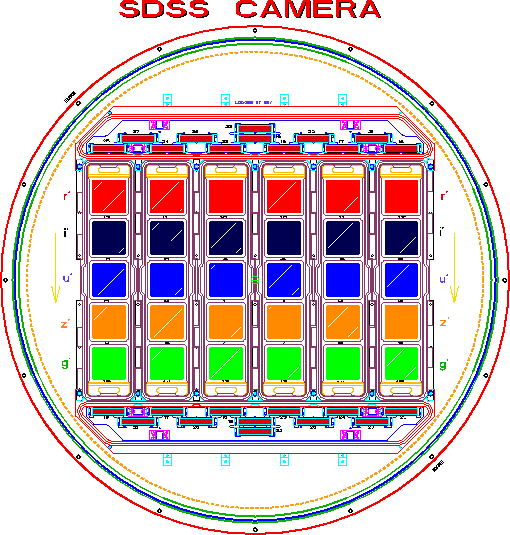
- A series of new, large sky surveys are coming on line, or are imminent:
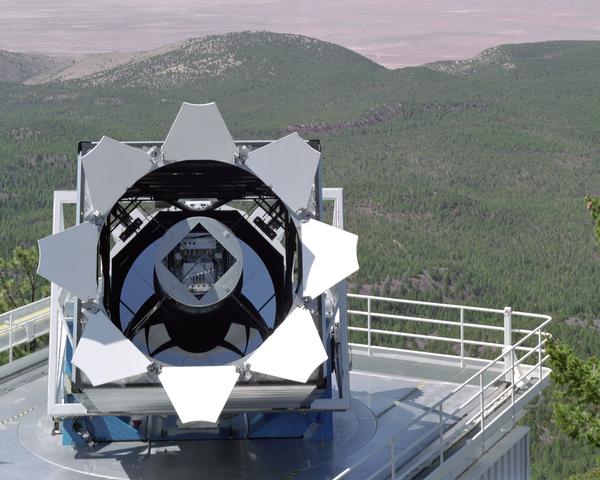
- Sloan Digital Sky Survey (SDSS) – in the image.
- Panoramic Survey Telescope & Rapid Response System (Pan-STARRS)
- The Large Synoptic Survey Telescope (LSST)
- None of these use the traditional BVRI filters.
- Observatories are not replacing their old UBVRI filter sets.
- Little or no new work is being done to support UBVRI despite its known
inadequacies.
|
|
13
|
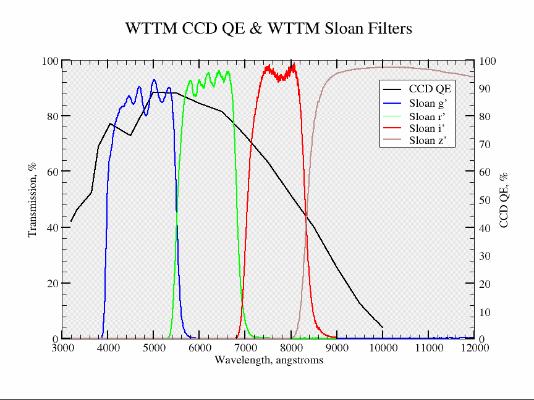
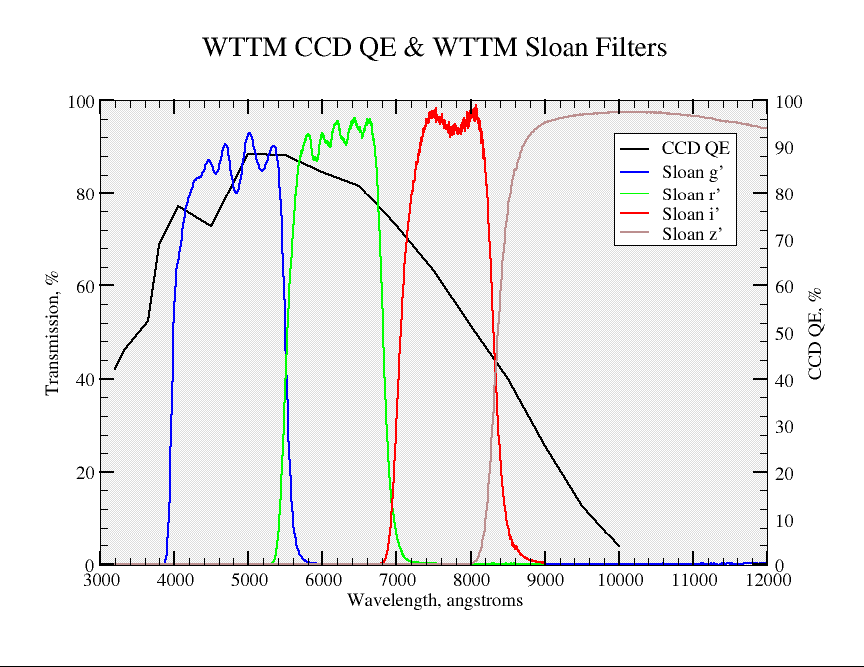
- Increasingly the new standard system is the Sloan Digital Sky Survey
filter system… ugriz.
- The ugriz system is optimised for stellar photometry.
- It is being used increasing widely and is the new “buzz word” in
photometry.
- UBVRI is likely to be extinct in professional astronomy in 10 years or
less.
|
|
14
|
|
|
15
|
|
|
16
|
- H-alpha falls in “r” and H-beta and H-gamma both fall in “g”.
- The “u” filter is broader than Johnson U. The two main metal lines in
stellar spectra (from calcium) fall inside “u”.
- So, photometry in ugr allows the metal content of stars to be
determined with great precision.
- ugriz photometry allows the physical parameters of stars to be
determined without spectroscopy (from CCD images in large surveys).
|
|
17
|
- BVRI filters are simple to mass produce (coloured glass) and thus cheap
– a reasonable set can be bought for a few hundred dollars.
- Sloan ugriz filters are special, interference filters and made to order.
- They are not catalogue items.
- A typical price is $3000-$10000 per filter.
- Smaller professional observatories cannot afford them.
- They are totally out of reach of 99.99% of amateurs at present.
- They have a limited lifetime and need replacing.
|
|
18
|
- There is a real danger of creating a two-speed structure in astronomy:
- Big observatories carrying out standardised photometry using the new
all-sky photometric catalogues in ugriz and producing the faint all-sky
calibration stars that CCDs need.
- Small observatories and amateurs marginalised by using an antiquated
system that cannot easily be homologated with new professional
photometry.
|
|
19
|
- One solution is to persuade filter manufacturers to offer ugriz filters
as catalogue items.
- By mass producing them, on the grounds that these will be the standard
filters that everyone will need to buy in the future, the cost could be
greatly reduced.
- IAU Commission 25 is charged with photometry and calibration.
- The progressive change to ugriz seems to be a “fait accompli”.
- But, Commission 25 will hopefully attempt to negotiate with
manufacturers to persuade them to produce cheaper ugriz.
- Astronomers will need to get used to the idea that UBVRI is on its way
out.
|

 Notas
Notas